A Green Transformation Panel and Youth Workshop was held at MAKÜ for COP31
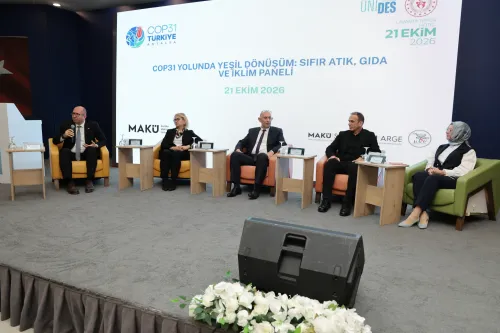
At the 'Green Transformation on the Road to COP31: Zero Waste, Food and Climate Panel' held at Burdur Mehmet Akif Ersoy University, topics such as climate change, carbon and water footprint, food security, and sustainable production were discussed. The program aimed to transform the youth's solution proposals into concrete action plans, and the contributions of MAKÜ to the COP31 process and afforestation efforts were also brought to the agenda.
Yapılış Tarihi | 23 October 2026, Friday

The 'Green Transformation on the Road to COP31: Zero Waste, Food and Climate Panel' was organized by the Food Engineering Research and Development Society of Burdur Mehmet Akif Ersoy University (MAKÜ), with the support of the Ministry of Youth and Sports' ÜNİDES and in partnership with the Sustainability Coordination and Research Development Coordination of MAKÜ.
The program focused on combating climate change, environmental awareness, zero waste, and sustainable food systems, aiming to enhance the climate literacy of young people and transform solution-oriented ideas into concrete action proposals.
Prof. Dr. Gürsoy: It is time to take action in the fight against climate change
The opening speech of the program was delivered by MAKÜ Vice Rector and COP31 University Coordinator Prof. Dr. Oğuz Gürsoy. Gürsoy emphasized that the fight against climate change should not be limited to decisions made at international meetings and highlighted the importance of transforming goals into actionable steps.
Gürsoy stated that the COP31 Climate Summit, which Turkey will host in Antalya from November 9-20, will be an important meeting for a sustainable future, expressing that reducing the effects of climate change, recycling waste, and conserving natural resources require a shared responsibility.
Prof. Dr. Gürsoy said, “It is time to take action. The fight against climate change will only be possible by taking shared responsibility and developing actionable solutions, not just by talking.”
Support for student projects from ÜNİDES
In his speech, Gürsoy also mentioned the opportunities offered by the ÜNİDES program conducted by the Ministry of Youth and Sports for student communities, announcing that the project prepared by the President of the Food Engineering Research and Development Society, Tuğçe Çeküç, and the community management has qualified for 75,000 TL support within the special call for COP31, Green Transformation, and Sustainability.
Gürsoy called on university students not to hesitate in preparing projects, stating that the realization of ideas by student communities is important for active participation in university life and social contribution.
Prof. Dr. Gürsoy drew attention to the fact that climate change is not only a matter of the future but also of today; he expressed that it is necessary to be prepared for extreme weather events, to make cities resilient to climate change, to conserve water resources, and to promote sustainable production and consumption habits.
Carbon and water footprint and food security were discussed
The panel moderated by Prof. Dr. Oğuz Gürsoy included speakers such as Prof. Dr. Zuhal Akyürek from the Faculty of Engineering and Architecture, Assoc. Prof. Dr. İlker Ünal from the Faculty of Science and Literature, Dr. Faculty Member Mesut Coşlu from the Faculty of Science and Literature, and Lecturer İkramiye Değer from the Altınyayla Mehmet Tuğrul Security Services Vocational School.
The panel focused on topics such as carbon footprint, reduction of carbon emissions, water footprint, food security, sustainable agriculture, and space debris.
During the panel, the decisive role of daily life habits in reducing carbon and water footprints was emphasized, and it was highlighted that water consumption should not only be evaluated through direct use. It was stated that the water used in the processes from the production of food to its supply and delivery to consumers is also part of the total water footprint.
Using the example that approximately 130 liters of water is used in the process from the production to the consumption of a cup of coffee, the dimensions of indirect water consumption were highlighted. The concepts of blue, green, and gray water footprints were also discussed, evaluating the impacts of products preferred in daily life from clothing to food on natural resources.
The panel emphasized the importance of food security in terms of people's access to sufficient and healthy food, raising the necessity of efficient production in the face of the increasing world population and consumption. It was stated that the effective use of Turkey's agricultural production capacity, the widespread adoption of digital agriculture applications, and the increase in productivity could reduce dependence on food imports.
The issue of space debris was also brought up in the panel, where mutual exchanges of views with students were held, sharing different perspectives on environmental issues.
Tree planting for green transformation
As part of the program, tree planting was carried out on behalf of the panelists through the TEMA Foundation to support the understanding of green transformation and sustainability with a lasting environmental contribution.
During the event, the importance of contributing to nature and strengthening environmental awareness with concrete steps was emphasized, highlighting the need to increase social awareness for a sustainable future.
Youth's solution proposals were discussed in the workshop
The program continued with a conference titled “Green Transformation: From Awareness to Action” by Dr. Faculty Member Kübra Ertan Türe, the Sustainability Coordinator of MAKÜ.
Following the conference, a Youth Workshop on Food Security, Zero Waste, and Climate Change was held. The workshop aimed for young people to express their ideas in the fields of environment, sustainability, and climate change and to develop actionable solutions to the problems.
It is planned that the proposals that will emerge from evaluations in round table groups will be reported and published on the university's official website, contributing to MAKÜ's sustainability efforts.